Stanford found walking raised creative output by about 60 percent. But it also made focused answers worse. Which meetings to take on foot, and which to keep at the table.
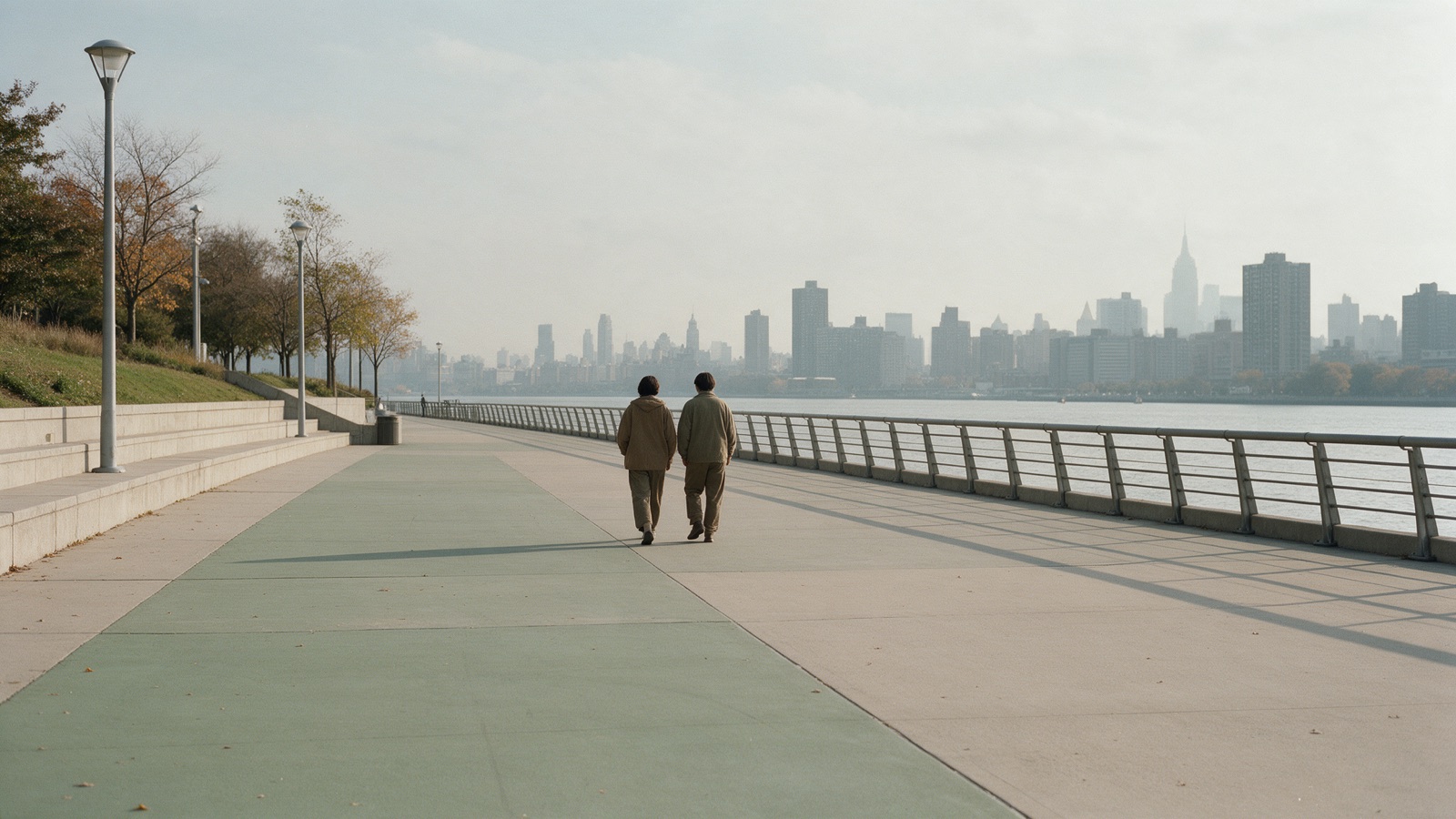
I run most of my one-on-ones on foot, and I get asked whether that is a preference or a strategy. It started as a preference. The research made it a strategy, with limits.
Oppezzo and Schwartz (2014) at Stanford ran four experiments with 176 people. Participants generated alternative uses for everyday objects, a standard test of divergent thinking, while sitting or walking. Walking produced about 60 percent more creative responses on average. It worked on a treadmill facing a blank wall, which means the effect comes from the walking itself, though walking outdoors produced the most novel analogies. The benefit lingered briefly after sitting back down.
The same study found the cost. On a test of convergent thinking, where there is one right answer, walkers did slightly worse than sitters. Walking opens the field. It does not narrow it.
Keinänen (2016) interviewed nine Norwegian academics who walk to think. They described using walks for specific stages: getting unstuck, letting an argument settle, rehearsing a talk. They chose routes that needed no navigation, and several said the rhythm of walking did the work. They avoided walking for tasks that needed reading or writing.
Bälter and colleagues (2018) moved graduate seminars outdoors and on foot in Stockholm. Participants rated the walking seminars higher in quality and reported better wellbeing than in the seated versions. Discussion improved. Note-taking did not.
Bilsland and Siebert (2024) reviewed the use of walking interviews in organizational research and found people disclose differently side by side than face to face. Sensitive topics come up more easily. The setting prompts memories and examples that a room does not.
Brown and colleagues (2014) had office workers walk twice a week at lunch for eight weeks, on green or built routes. Physical activity rose in both groups, and the green-route walkers showed improved autonomic recovery. The walks in that study were social and unstructured.
The Stanford treadmill finding suggests any steady, low-demand movement helps divergent thinking. Standing works for some people. For a seated meeting you want to open up, the closest substitute is a change of room and a window with a view. The research on views is thinner than the research on walking, but it points the same way.
No, for the creativity effect. The treadmill worked. Outdoors adds mood and stress benefits covered elsewhere in these notes, and it produced the most original ideas in the Stanford data.
Voice memo at the end, or two minutes on a bench before you part. Every study that tried live notes reported it broke the walk.
The benefit appeared at a slow pace. Distance was never the variable. A short loop at whatever pace suits both of you is the whole method.
Two Humans in the Loop is a 30-minute guided walk at Hudson Yards designed for exactly two people and one conversation.
On the science: every study named here is real and linked below. The summaries and takeaways are my own reading of them, simplified to be useful rather than complete. Where a detail matters to you, the paper is one click away.